
Practical guidance for life at home
VA Benefits for Home Upgrades: Understanding HISA and the Forms You Need

If getting through the front door or stepping into the bathtub has become difficult, the next question is often about money: can VA benefits help make the house easier to live in? For some Veterans, the answer is yes. The important part is matching the improvement to the right benefit—not assuming that one form will pay for any remodel.
What a VA HISA grant actually pays for
HISA stands for Home Improvements and Structural Alterations. It is a VA benefit for medically necessary changes to a Veteran's or eligible Servicemember's primary residence. Think access and daily function: getting into the home, using essential bathroom facilities, reaching a sink, or making the house ready for prescribed medical equipment. It is not a general home-renovation allowance.
That distinction matters when you describe the project. A bathroom that looks dated is a remodeling concern. A tub edge that a person cannot safely step over because of a disability is an access concern. The application needs to connect the proposed construction to the medical need, and the VA decides whether the connection and the work qualify.
You do not necessarily need a service-connected disability to be considered for HISA. The program includes service-connected and non-service-connected conditions, although the benefit category and available amount differ. Start with the Prosthetic and Sensory Aids Service at the VA facility where you receive care rather than ruling yourself out based on something you read in a contractor's advertisement.
A safer shower, an easier entrance, or a sink within reach
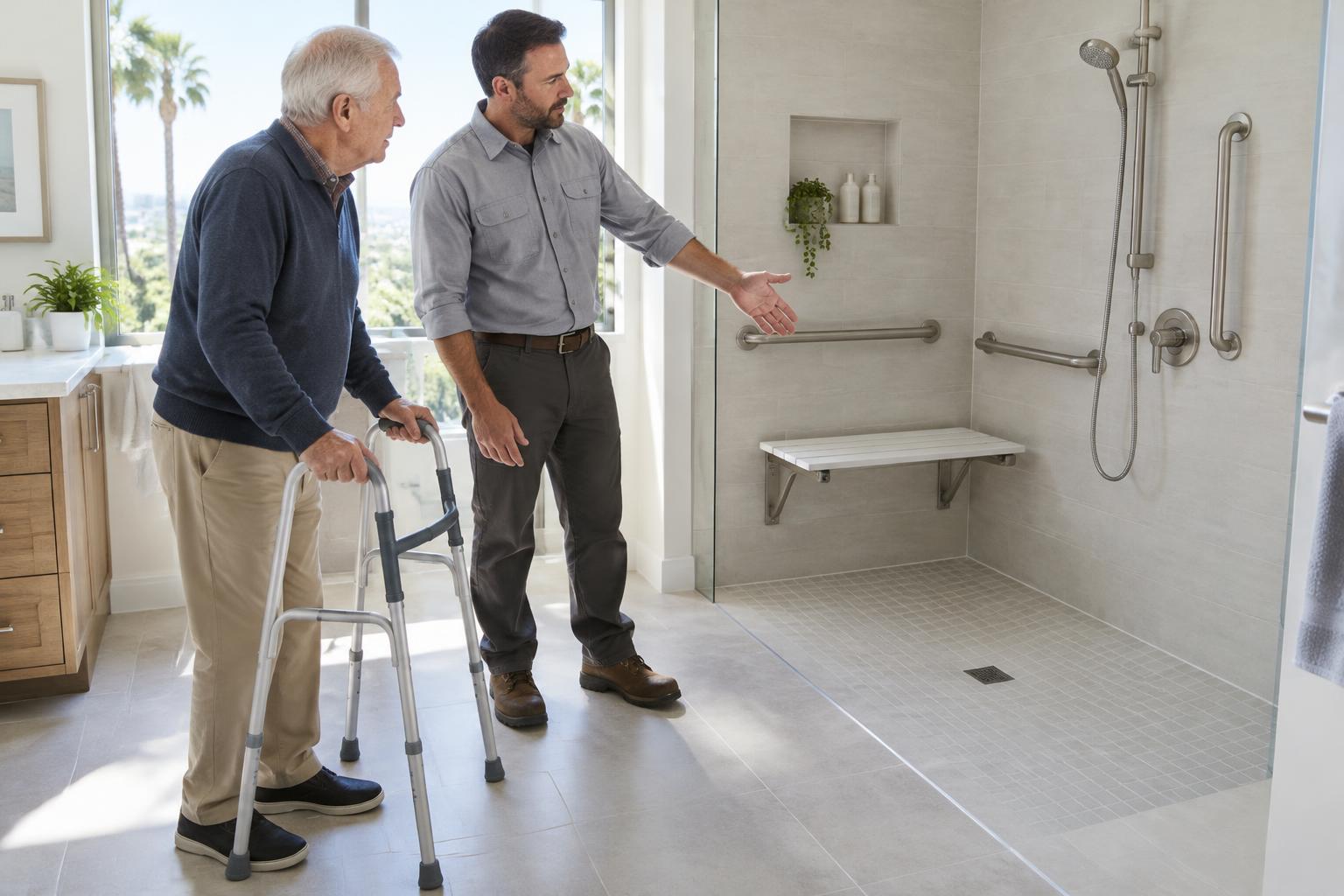
The VA identifies roll-in showers as an example of improvements that can provide access to essential sanitary facilities. If a tub is the obstacle, the useful conversation is about the entry, clear space, drainage, support, and the way the person bathes—not simply swapping one product for another. Medical justification and approval still apply; a walk-in shower is not automatically covered just because it is marketed for seniors.
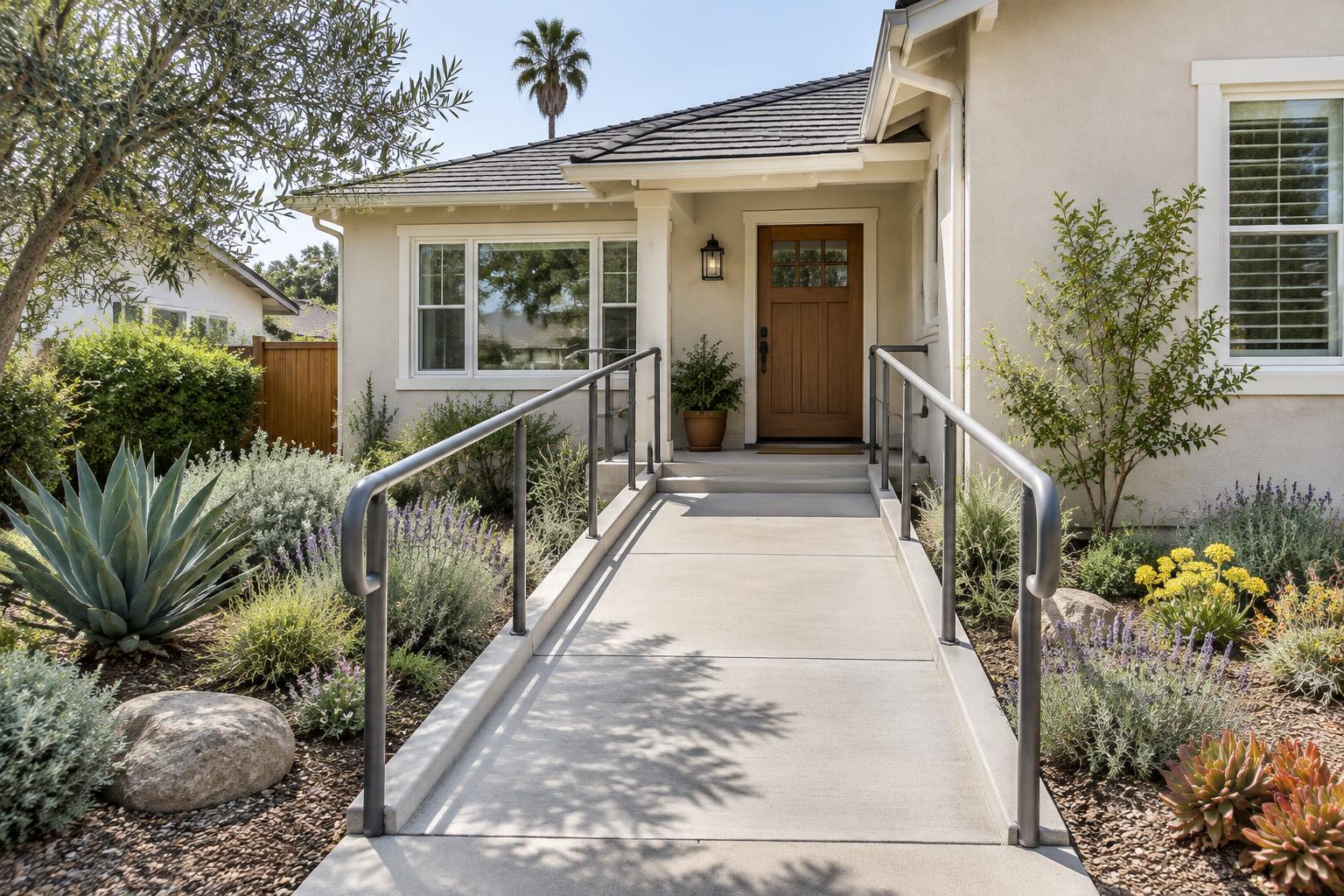
A permanent ramp may address an entrance that cannot be used with a wheelchair or walker. In an older Los Angeles bungalow, the rise at the porch, available yard space, door swing, and landing can determine what is practical. On a hillside property, a short-looking entrance problem may need a much more carefully planned route. The design has to work at the actual address.
HISA can also include changes that make kitchen or bathroom sinks and counters accessible, and plumbing or electrical changes made necessary by home medical equipment. It does not cover every feature associated with accessibility, every cosmetic finish, or an entire kitchen simply because part of it needs adapting. The VA lists exclusions including new construction, exterior decking, hot tubs, spas, and walkways to exterior buildings. Ask about your exact scope before budgeting around a benefit.
How much help can HISA provide?
The VA currently describes two lifetime HISA benefit limits: up to $6,800 for qualifying higher-benefit categories and up to $2,000 for other qualifying disabilities. These are lifetime limits, not yearly allowances, and they are not automatic payments. Previous HISA use can reduce what remains available.
The $6,800 category includes work addressing a service-connected disability and certain disabilities treated as if service-connected. It can also include work for a non-service-connected disability when the Veteran has a service-connected disability rated at least 50 percent under the program's rules. The official guidance cautions that disability percentages cannot simply be combined to establish that threshold. Let the VA determine the applicable category rather than trying to calculate eligibility from several ratings yourself.
Even the higher limit may pay for only part of a substantial bathroom conversion or entrance project. Ask for an estimate that separates the medically necessary work from optional finishes, then discuss any difference between the approved benefit and the total price. The amounts here were checked against official VA guidance in October 2026; confirm your current entitlement and remaining balance with your local Prosthetic and Sensory Aids Service.
What VA Form 10-0103 does—and what goes with it
VA Form 10-0103 is the Veterans Application for Assistance in Acquiring Home Improvements and Structural Alterations. It is the application associated with HISA. Download the current version from VA.gov rather than using an old copy saved on another website. The form's instructions say to submit it to the VA health care facility where the Veteran receives care.
The signed form is only one part of the package. The VA requires a prescription written or approved by a VA physician. That prescription needs to describe the proposed project, the area being changed, alternatives, and the diagnosis and medical justification. A general statement that someone would benefit from a nicer bathroom is not the same as documentation explaining why a particular alteration is clinically appropriate.
The package also calls for a written itemized estimate covering labor, materials, permits, and inspections, plus a color photograph of the area before the improvement. A renter needs a signed and notarized statement from the property owner authorizing the alteration. The VA may inspect the site. If you need an advance payment, the official instructions say to request it on the application; ask the VA how its payment process applies to your project before agreeing to a construction schedule.
Keep medical records, claim details, and identification numbers out of a contractor's ordinary contact form. Submit the benefit application through the VA's instructed process. A remodeling professional can describe the construction and cost, but that does not make the contractor your benefits representative.
Talk to the VA before you start the work
The safest order is to explain the daily access problem to your VA care team, confirm the application requirements with Prosthetics, gather the medical and project documents, and obtain written approval before construction starts. Do not treat an estimate, a verbal conversation, or a submitted form as authorization to spend money expecting reimbursement.
Describe the problem in ordinary language first. Perhaps you cannot clear the tub edge, cannot reach the sink from a wheelchair, or cannot get from the driveway to the front door without assistance. Those details give the clinician and the contractor something specific to evaluate. Photographs and measurements can help explain the building, but they do not replace the VA's medical determination.
If the project changes after approval, stop and ask the VA whether the revised scope or price needs another review. Keep copies of the approval, estimate, and receipts, and ask what completion documents or inspections will be required. Nobody should promise you a fixed approval timeline or guaranteed reimbursement based on a few photos.
HISA is different from SAH and SHA housing grants
You may also see Specially Adapted Housing (SAH) and Special Home Adaptation (SHA) grants mentioned in searches for VA home improvement help. These are separate adapted-housing programs for Veterans and Servicemembers with certain qualifying service-connected disabilities. Their eligibility, ownership rules, and funding limits are not the same as HISA. They can support more extensive housing adaptations when the person and project qualify.
SAH generally requires that the Veteran owns or will own the permanent home. SHA can apply to a permanent home owned or to be owned by the Veteran or a family member. Those broad descriptions are not a substitute for the VA's specific disability criteria. A disability rating alone does not establish eligibility for either grant.
The application is different too. SAH and SHA use VA Form 26-4555, or the VA's online adapted-housing application—not Form 10-0103. Their maximum amounts change by fiscal year, so use the current figures on VA.gov rather than an undated remodeling article. There is also a Temporary Residence Adaptation (TRA) option for some people eligible for SAH or SHA who are temporarily living in a family member's home.
The VA explains that a Veteran may receive HISA and either SAH or SHA. That does not mean the same expense can simply be submitted twice. Ask the relevant VA teams how the benefits would be coordinated for the proposed work, and what each approval covers.
A VA home loan is not a home-modification grant
The phrase ‘VA benefits for home upgrades’ can bring together very different products. A VA-backed home loan is financing, with repayment obligations. HISA and adapted-housing grants are assistance programs with their own medical or disability-related criteria. Receiving one VA benefit does not automatically qualify you for all the others.
If you do not qualify for a grant, or the approved amount leaves a gap, there may be other local programs or financing options worth discussing. Compare the full terms rather than focusing only on the monthly payment. A benefits professional or qualified financial adviser can help with decisions that go beyond a construction estimate.
Bring the everyday difficulty into focus
For a Los Angeles family, a good starting point is often one room or one route—not a whole-house renovation. Look at what happens when the Veteran gets home, uses the bathroom, or prepares a meal. The improvement should remove a real obstacle and remain comfortable for everyone else living there.
Aging in Comfort can assess the space, explain construction options, and prepare a project scope and estimate for you to discuss with the VA. We are an independent home-modification business, not the Department of Veterans Affairs, and we do not decide benefit eligibility or guarantee grant approval. The VA handles the benefit decision; our role is to help make the proposed home improvement clear, practical, and suited to the person using it.
Keep exploring with our home-modification funding guide or our home assessment guide.
Make your next VA conversation more concrete
Tell us which part of your Los Angeles home has become difficult to use. We can help you explore modifications and prepare a clear project estimate while you confirm benefit eligibility and approval with the VA.